I. Tianjin Shipping Index (TSI)
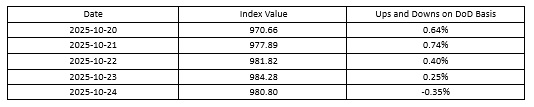
In Week 43, 2025 (Oct.20 to Oct.24), Tianjin Container Freight Index (TCI) increased steadily. Tianjin Bulk Freight Index (TBI) fluctuated slightly. Tianjin Domestic Container Freight Index (TDI) continued to rise sharply. The TSI saw a surge followed by a pullback, eventually closing at 980.80 points, with a cumulative increase of 20.41 points or 2.13% from Oct.17 (the last release day of Week 42). The trend of TSI is as follows:
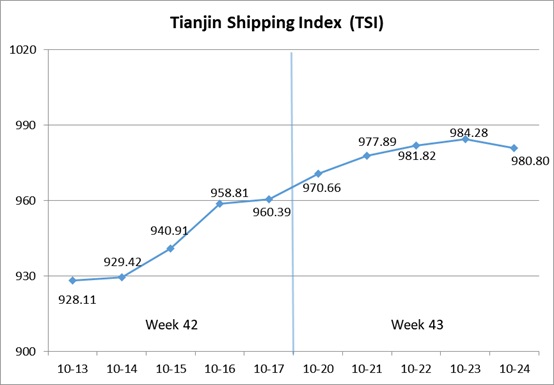
The value and trend of TSI is as follows:
II. Tianjin Container Freight Index (TCI)
In Week 43, 2025 (Oct.20 to Oct.24), the trend of Tianjin Container Freight Index (TCI) is as follows:
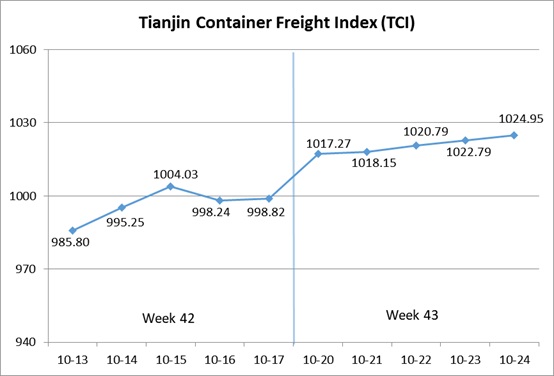
In Week 43, the TCI increased gradually.
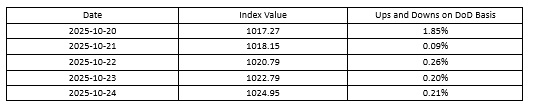
From Oct.20-Oct.22 (Mon.-Wed.), the freight rates in European route and Mediterranean West route increased slightly, and the freight rate in Mediterranean East route decreased at first and then increased. The freight rates in American route and Persian Gulf route increased significantly, and the freight rate in South American route decreased significantly. The TCI continued to increase, with a cumulative increase of 2.20% on three releasing days. From Oct.23-Oct.24 (Thur.-Fri.), the freight rate in European route decreased slightly, and the freight rate in Mediterranean route increased strongly. The freight rate in South American route continued to decrease, and the freight rates in American route and Persian Gulf route kept steady. The TCI increased, with a cumulative increase of 0.41% on two releasing days.
Finally, the TCI closed at 1024.95 points, with a cumulative increase of 26.13 points (2.62%) from Oct.17 (the last release day of Week 42).
The TCI index value and several ups and downs on a day-on-day basis are as follows:
The TCI includes 19 sample routes. The main route analysis of this week is as follows:
European/Mediterranean route The market supply of shipping capacity was tight, and at the same time, important ports such as Rotterdam and Antwerp were experiencing severe congestion due to strikes, leading to increased berthing operation durations for liners. Shipping companies continued to raise freight rates. The freight indices in European route, Mediterranean East route and Mediterranean West route closed at 612.21 points, 786.37 points and 1010.60 points, with the cumulative increase of 1.17%, 3.09% and 3.49%.
American route Due to insufficient market capacity, some shipping companies were short of containers, and spot space was tight. Freight rates increased significantly this week. The freight indices in American West Coast route and American East Coast route closed at 877.79 points and 822.91 points, with the cumulative increase of 13.20% and 5.15%.
South American route The market cargo volume remained low, while shipping capacity was relatively abundant. Shipping companies continued to offer special rates for shipping space, and freight rates saw a significant decline this week. The freight indices in South American West route, South American East route and Central and South American route closed at 828.05 points, 1351.60 points and 976.59 points, with the decrease of 8.78%, 6.88% and 9.04% on a week-on-week basis.
Persian Gulf route Shipping companies continued to suspend operations, and the freight rate increased significantly this week. The freight index for the route from Tianjin to the Persian Gulf closed at 766.37 points, with the increase of 12.37% on a week-on-week basis.
III. Tianjin Bulk Freight Index (TBI)
In Week 43, 2025 (Oct.20 to Oct.24), the trend of Tianjin Bulk Freight Index (TBI) was released as shown as follows:
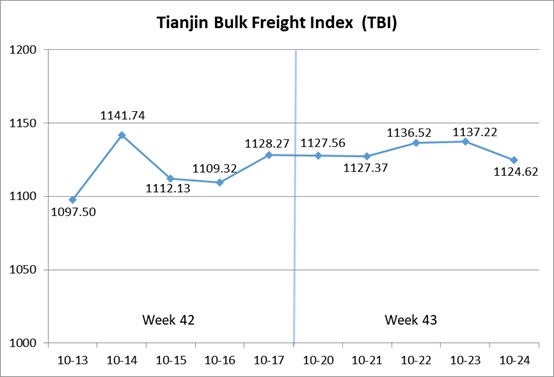
In Week 43, the TBI remained stable overall.
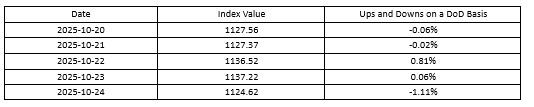
From Oct.20 to Oct.21 (Mon. to Tue.), the freight rates of coal, grain, and metal ore market all declined slightly, dragging TBI down by a cumulative 0.08% over the two release days. Subsequently, the freight rates of coal and metal ore market rose slightly, while the freight rate of grain market remained generally stable. TBI increased by a cumulative 0.87% from Oct.22 to Oct.23 (Wed. to Thur.). On Oct.24 (Fri.), metal ore market saw a slight decline in the freight rate, pulling TBI down again, ultimately closing at 1124.62 points, with a cumulative decrease of 3.65 points or 0.32% compared to Oct.17 (the last release day of Week 42).
The TBI index value and several ups and downs on a day-on-day basis are as follows:
The Tianjin Bulk Coal Freight Index (TBCI) Closed at 848.92 points, a cumulative decrease of 2.20 points or 0.26% compared to Oct.17 (the last release day of Week 42). In the supramax ship market, there was a slight increase in Indonesian coal shipments, but failed to fully absorb the excess shipping capacity in the market. The freight index for the Indonesia to Qingdao route edged down by 0.66% on a weekly basis.In the Capesize ship market, the freight index for the Hay Point to Qingdao route fluctuated narrowly, falling 0.02% on a weekly basis.
The Tianjin Bulk Grain Freight Index (TBGI) Closed at 943.74 points, a cumulative increase of 1.44 points or 0.15% compared to Oct.17 (the last release day of Week 42). The grain transportation market was generally sluggish, with freight rates fluctuating slightly. The freight index for the South America to Tianjin route increased by 0.25% on a weekly basis, and the index for the US Gulf to Tianjin route increased by 0.09% on a weekly basis, and the index for the West America to Tianjin route increased by 0.10% on a weekly basis.
The Tianjin Bulk Mineral Freight Index (TBMI) Closed at 1581.19 points, a cumulative decrease of 10.19 points or 0.64% compared to Oct.17 (the last release day of Week 42). In terms of iron ore, miners were cautious at the beginning of the week, leading to a slight decrease in market freight rates. In the middle of the week, weather factors caused delays in some shipping capacity, which increased the willingness of ship owners to raise prices and led to a significant increase in market freight rates.In the later part of the week, the FFA forward contract freight rate fell, and market freight rates dropped again. The freight index for the Western Australia to Northern China route decreased by 0.55% on a weekly basis, and the index for the Brazil to Tianjin route declined by 1.27% on a weekly basis. In terms of nickel ore, cargo orders were scarce, and the freight index for the Surigao to Tianjin route remained generally stable, with an increase of 0.01% on a weekly basis.
IV. Tianjin Domestic Container Freight Index (TDI)
In Week 43 (Oct.20 to Oct.24), the trend of the Tianjin Domestic Container Freight Index (TDI) is shown in the chart below:
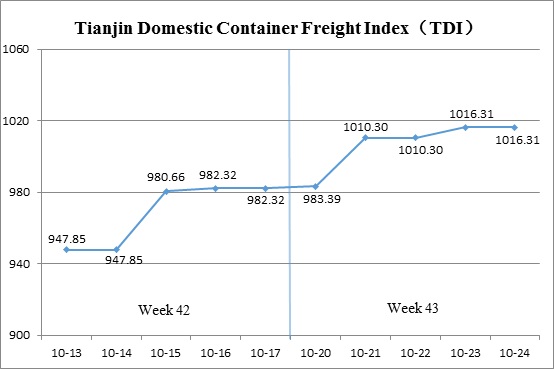
In Week 43, the Tianjin Domestic Container Freight Index continued its upward trend.
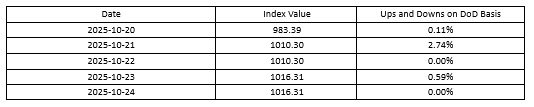
On Oct.20 (Mon.), the inbound index recorded a slight increase, leading to a modest rise in the TDI. On Oct.21 (Tue.), the outbound index edged up, while the inbound index gained further momentum, driving the TDI sharply higher and pushing it above the 1,000-point mark. The TDI remained stable on Oct.22 (Wed.). On Oct.23 (Thur.), both the outbound and inbound indices posted small gains, lifting the TDI further before it stabilized on Oct. 24 (Fri.). The index ultimately closed at 1,016.31 points, up 33.99 points or 3.46%, compared with Oct. 17 (the last release day of Week 42).
The TDI index value and several ups and downs on a day-on-day basis are as follows:
The Tianjin Domestic Container Outward Freight Index (TDOI) Continued its upward trend, closing at 1,054.70 points on Oct.24, an increase of 26.43 points or 2.57% compared with Oct.17 (the last release day of Week 42). Cargo volumes in Tianjin’s domestic outbound container shipping market maintained steady growth, leading to increasingly tight vessel capacity. Freight rates on routes to Fujian and South China continued to rise, with the Tianjin-Quanzhou/Xiamen route and the Tianjin-Guangzhou route closing at 1,241.59 points and 1,017.65 points, up 2.46% and 2.88% on a week-on-week basis respectively. Freight rates on the Tianjin-Shanghai route remained stable, with the index unchanged at 1,060.93 points on a week-on-week basis.
The Tianjin Domestic Container Inward Freight Index (TDII) Maintained its upward momentum, closing at 977.91 points on Oct.24, an increase of 41.55 points or 4.44% compared with Oct.17 (the last release day of Week 42). Affected by colder weather in northern regions, the shipment of temperature-sensitive cargo from southern areas accelerated, driving up transport demand in South China and Fujian. Freight rates continued to rise, with the Quanzhou/Xiamen-Tianjin and Guangzhou-Tianjin routes closing at 797.25 points and 1,011.47 points, up 4.69% and 5.07% on a week-on-week basis respectively. The freight rate on the Shanghai-Tianjin route remained stable, with the index unchanged at 1,061.42 points on a week-on-week basis.
(The analysis report is for reference only and at your own risk)


