I. Tianjin Shipping Index (TSI)
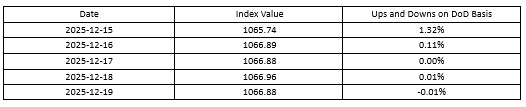
In Week 51, 2025 (Dec.15 to Dec.19), Tianjin Container Freight Index (TCI) continued to increase. Tianjin Bulk Freight Index (TBI) stopped falling and stabilized. Tianjin Domestic Container Freight Index (TDI) kept steady. The TSI increased at the beginning of the week and then fluctuated in a narrow range, eventually closing at 1066.88 points, with a cumulative increase of 15.04 points or 1.43% from Dec.12 (the last release day of Week 50). The trend of TSI is as follows:
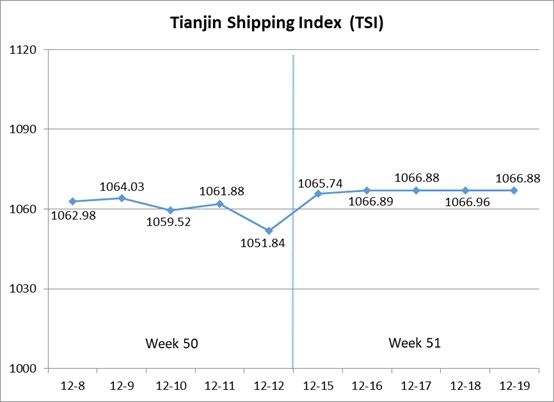
The value and trend of TSI is as follows:
II. Tianjin Container Freight Index (TCI)
In Week 51, 2025 (Dec.15 to Dec.19), the trend of Tianjin Container Freight Index (TCI) is as follows:
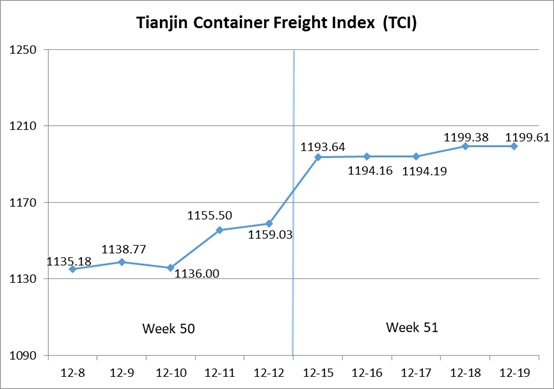
In Week 51, the TCI increased rapidly and then increased slowly.
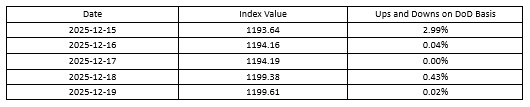
On Dec.15 (Mon.), the freight rates in Mediterranean route and American route climbed rapidly, and the freight rates in European route and Persian Gulf route continued the upward trend seen in the latter part of last week. The freight rate in South American route decreased significantly. The TCI rose strongly, with a daily increase of 2.99%. From Dec.16-Dec.19 (Tue.-Fri.), the freight rates in European route and American West Coast route remained stable with a slight decrease, and the freight rates in Mediterranean route and American East Coast route continued to increase. The freight rate in Persian Gulf route fluctuated in a narrow range, and the freight rate in South American route still showed a downward trend. The TCI increased slowly, with the cumulative increase of 0.50% over the four release days.
Finally, the TCI closed at 1199.61 points, with the cumulative increase of 40.58 points (3.50%) from Dec.12 (the last release day of Week 50).
The TCI index value and several ups and downs on a day-on-day basis are as follows:
The TCI includes 19 sample routes. The main route analysis of this week is as follows:
European/Mediterranean route The major ports in Europe were severely congested, and the turnover efficiency of shipping vessels continued to decline. Shipping companies were imposing demurrage charges and container detention charges, which drove up freight rates. The freight index closed at 696.72 points, with the increase of 1.29% on a week-on-week basis. At the end of the year, the market cargo volume of the Mediterranean route was concentrated and released, and the shortage of cabin space was more obvious, so freight rates increased greatly. The freight indices in Mediterranean East route and Mediterranean West route closed at 1114.40 points and 1406.69 points, with the increase of 12.44% and 10.63% on a week-on-week basis.
American route China will launch the export license system for steel and related products on New Year’s Day next year. Domestic factories and traders were accelerating their shipment pace, and the market volume was recovering. This week shipping companies were implementing price increase plans, resulting in fluctuating freight rates. The freight indices in American West Coast route and American East Coast route remained at 777.19 points and 764.99 points, with the increase of 5.48% and 9.27% on a week-on-week basis.
South American route The inventory of local enterprises was at a high level, and the willingness to replenish imports was weak, the transportation market volume was weak, and the overall cabin space was significantly surplus. This week freight rates dropped significantly. The freight indices in South American West route, South American East route and Central and South American route closed at 724.48 points, 851.50 points and 809.38 points, with the decrease of 6.36%, 15.11% and 11.19% on a week-on-week basis.
Persian Gulf route The market cargo volume stopped falling and rebounded. In the early stage, shipping companies reduced their voyages and there was a shortage of heavy container space, which led to a fluctuating increase in the freight rate this week. The freight index in Tianjin-Persian Gulf route closed at 991.82 points, with the increase of 2.50% on a week-on-week basis.
III. Tianjin Bulk Freight Index (TBI)
In Week 51, 2025 (Dec.15 to Dec.19), the trend of Tianjin Bulk Freight Index (TBI) was released as shown as follows:
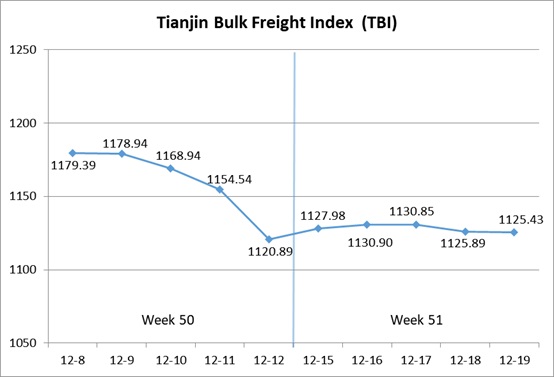
In Week 51, TBI stabilized after a decline.
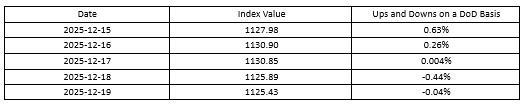
From Dec.15 to Dec.16 (Mon. to Tue.), grain market freight rates remained weak, while coal market freight rates recovered slightly and metal ore market freight rates rebounded significantly, driving TBI to stop its decline and recover, with a cumulative increase of 0.89% over the two release days. From Dec.17 to Dec.19 (Wed. to Fri.), grain market freight rates fell further, while coal and metal ore market freight rates fluctuated narrowly. The TBI declined slightly and finally closed at 1125.43 points, with a cumulative increase of 4.54 points or 0.40% compared to Dec.12 (the last release day of Week 50).
The TBI index value and several ups and downs on a day-on-day basis are as follows:
Tianjin Bulk Coal Freight Index (TBCI) Closed at 870.89 points, a cumulative increase of 6.34 points or 0.73% compared to Dec.12 (the last release day of Week 50). In terms of the supramax market, the demand for coal imports weakened, and Indonesian coal cargo parcels were limited, driving the freight index for the Indonesia to Qingdao route to decrease by 0.94% on a weekly basis. In terms of Capesize ship market, freight rates rebounded overall, driving the freight index for the Hay Point to Qingdao route to increase by 1.70% on a weekly basis.
Tianjin Bulk Grain Freight Index (TBGI) Closed at 903.26 points, a cumulative decrease of 24.18 points or 2.61% compared to Dec.12 (the last release day of Week 50). Approaching the end of the year,grain import purchases slowed down, there was an oversupply of Panamax ship capacity, and market freight rates continued to decline.The freight index for the South America to Tianjin route decreased by 3.51% on a weekly basis, the index for the US Gulf to Tianjin route fell by 2.28% on a weekly basis, and the index for the West America to Tianjin route dropped by 1.29% on a weekly basis.
Tianjin Bulk Mineral Freight Index (TBMI) Closed at 1602.14 points, a cumulative increase of 31.45 points or 2.00% compared to Dec.12 (the last release day of Week 50). In terms of iron ore, Australian miners were active at the beginning of the week, driving a rebound in freight rates in the Pacific market, which slightly declined in the later part of the week. The freight index for the Western Australia to Northern China route increased by 1.92% on a weekly basis. The capacity in the Atlantic region was tight, and shipowners had a strong willingness to maintain high prices, leading to a significant increase in market freight rates. The freight index for the Brazil to Tianjin route rose by 5.10% on a weekly basis. In terms of nickel ore, the available capacity of supramax ships accumulated, and the freight index for the Surigao to Tianjin route decreased by 3.35% cumulatively this week.
IV. Tianjin Domestic Container Freight Index (TDI)
In Week 51 (Dec.15 to Dec.19), the trend of the Tianjin Domestic Container Freight Index (TDI) is shown in the chart below:
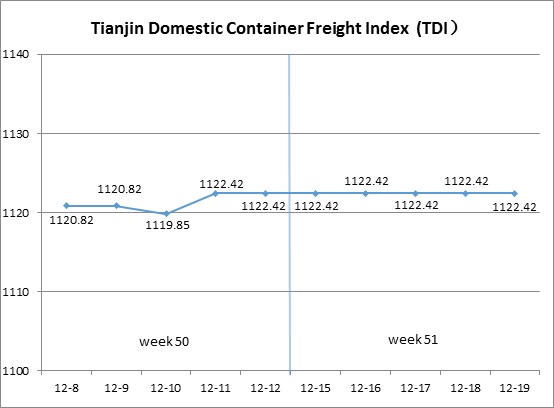
In Week 51, the Tianjin Domestic Container Freight Index remained stable.
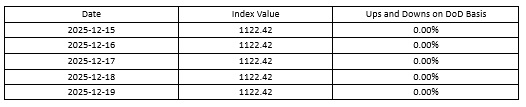
This week, the inbound and outbound indices remained stable, with TDI closing steadily at 1122.42 points, unchanged from Dec.12 (the last release day of Week 50).
The TDI index value and several ups and downs on a day-on-day basis are as follows:
The Tianjin Domestic Container Outward Freight Index (TDOI) Stopped falling and stabilized, closing at 1182.97 points on Dec.19, unchanged from Dec.12 (the last release day of Week 50). In recent winter, the northern region was foggy, and many areas carried out environmental protection measures. Facilities and equipment maintenance were carried out in factories, mines, and other areas. The peak season for the outbound market gradually faded, and market freight rates remained stable this week. The freight rates for the Tianjin to Guangzhou route, Tianjin to Quanzhou/Xiamen route, and Tianjin to Shanghai route closed at 1140.27 points, 1444.74 points, and 1103.09 points, respectively, unchanged on a weekly basis.
The Tianjin Domestic Container Inward Freight Index (TDII) Remained stable, closing at 1061.86 points on Dec.19, unchanged from Dec.12 (the last release day of Week 50). Affected by weather conditions, emergency response measures were launched in Tianjin and surrounding areas. The construction of soil and rock engineering projects was delayed, and heavy emission vehicles were restricted, leading to a decline in market demand. This week, the freight rates in the Tianjin inbound container market remained stable. The freight indices for the Shanghai to Tianjin route, Quanzhou/Xiamen to Tianjin route, and Guangzhou to Tianjin route closed at 1049.39 points, 807.97 points, and 1127.06 points, respectively, unchanged on a weekly basis.
(The analysis report is for reference only and at your own risk)


